Abuse Stack
Review
2026 platform index / B2B software decisions

Best abuse detection platforms.
Compare the whole stack.

Compare 15 platforms and alternatives for account abuse, automated traffic, content safety and commerce risk. See the scores, evidence, access and integration behind each option.

15platforms analyzed
41criteria per platform
7scoring categories
2026Product facts checked
October 22, 2026

Choose your surface

What are you protecting?

The same word, “abuse,” can describe very different jobs. Compare the decision before the brand.

The comparison

Fifteen platforms, one framework.

Inspect the criteria ↗

Read each editorial score alongside its product scope. A content classification, a device relationship and a transaction decision provide different evidence.

Fifteen abuse detection platforms: editorial scores, detection approach, result and current starting access. Product facts checked October 22, 2026.
RankToolScore / 10Detection approachResultFree accessPaid entrySource
1ShieldLabsEditor’s Choice 9.5out of 10Account and visitor riskRisk score; Trusted, Suspicious, Dangerous; four High-Risk Events5,000 free identifications99 US dollars/month for 25,000 identificationsVendor page
2Sift 9.0out of 10Digital trust and fraud decisioningScores, decisions and investigation workflowsSales-assisted evaluation; no public recurring free tierCustom quoteVendor page
3Castle 8.8out of 10Account security and device behaviorRisk scores, signals and configurable policies5 US dollars API usage/month: up to 1,000 Risk API callsPro: 200 US dollars/month, including 40,000 Risk API callsVendor page
4SEON 8.7out of 10Digital footprint and fraud operationsFraud scores, rules and investigation contextTrial requestStarter: 699 US dollars/month for 2,500 fraud checksVendor page
5DataDome 8.6out of 10Automated traffic and edge protectionTraffic classification and mitigationSales-assisted trial or demoEssentials: 3,830 US dollars/month; higher plans and account protection differVendor page
6Arkose Labs 8.5out of 10Bot and account-abuse defenseRisk, device context and adaptive interventionSales-assisted evaluationCustom quoteVendor page
7Fingerprint 8.4out of 10Device identity and risk signalsVisitor identification, Smart Signals and risk contextUp to 1,000 API calls/month; Pro Plus trialPro Plus: 99 US dollars/month for 20,000 API callsVendor page
8Hive 8.3out of 10Multimodal content moderationContent-category classifications and scoresPublic model demos; API access conditions varyModel and usage-specific pricingVendor page
9Sardine 8.2out of 10Device, behavior and financial crimeRisk decisions and fraud/AML operationsSales-assisted evaluationCustom quoteVendor page
10Cinder 8.0out of 10Trust and safety operations and AI safetyPolicy-aligned detection, review and enforcement workflowsSales-assisted demoCustom quoteVendor page
11Forter 7.9out of 10Commerce fraud and policy abuseAccount, order and policy-abuse decisionsSales-assisted evaluationCustom quoteVendor page
12Signifyd 7.7out of 10Commerce and return abuseOrder and return-policy decisionsSales-assisted evaluationCustom commercial termsVendor page
13Riskified 7.5out of 10Commerce identity and policy abuseAccount, checkout and policy decisionsSales-assisted evaluationCustom quoteVendor page
14Stripe Radar 7.3out of 10Payment, account and customer abuseRisk levels, entitled scores and abuse signalsRadar Lite included with standard Payments pricingBusiness Standard from 10 US dollars/month; Pro from 20Vendor page
15Feedzai 7.1out of 10Financial fraud and RiskOpsTransaction, account and investigation risk decisionsSales-assisted demoCustom quoteVendor page

Scores are editorial assessments under the 41-criterion rubric. Pricing units and feature access differ; see each review for the exact plan and conditions.

Platform directory

Read the evidence behind the score.

02

Digital trust and fraud decisioning

Sift

Sift combines fraud decisioning and a shared intelligence network across payment, account and marketplace use cases. Its wider suite is relevant when a team needs risk decisions and operational investigation in one procurement.

Evaluation: Sales-assisted evaluation; no public recurring free tier

9.0out of 10
03

Account security and device behavior

Castle

Castle connects device and behavior signals to signup, login and account-security decisions. Its pricing separates API usage units, so a Risk API call and an IP lookup should be costed separately.

Evaluation: 5 US dollars API usage/month: up to 1,000 Risk API calls

8.8out of 10
04

Digital footprint and fraud operations

SEON

SEON combines device intelligence, digital footprint enrichment and fraud rules with investigation tools. It fits workflows where contact, network and transaction context should inform one reviewable decision.

Evaluation: Trial request

8.7out of 10
05

Automated traffic and edge protection

DataDome

DataDome protects websites, mobile apps and APIs from automated abuse. Its bot-protection layer distinguishes legitimate automation from abusive traffic and applies mitigation near the request path.

Evaluation: Sales-assisted trial or demo

8.6out of 10
06

Bot and account-abuse defense

Arkose Labs

Arkose Labs offers bot and account-abuse protection with device identity, adaptive enforcement and operational visibility. Evaluate the entitled products together; the current platform is broader than a challenge widget.

Evaluation: Sales-assisted evaluation

8.5out of 10
07

Device identity and risk signals

Fingerprint

Fingerprint provides device identification and risk signals that help connect returning activity across account events. Its free and paid access make identity behavior inspectable before a broader integration.

Evaluation: Up to 1,000 API calls/month; Pro Plus trial

8.4out of 10
08

Multimodal content moderation

Hive

Hive classifies text, image, video and audio content for moderation and other AI tasks. A content category score answers a different question from an account-risk score, making the content layer complementary to identity and abuse signals.

Evaluation: Public model demos; API access conditions vary

8.3out of 10
09

Device, behavior and financial crime

Sardine

Sardine combines device and behavioral intelligence with onboarding, transaction-fraud and financial-crime workflows. Its modular platform suits teams that need more than account-linking evidence at the point of registration.

Evaluation: Sales-assisted evaluation

8.2out of 10
10

Trust and safety operations and AI safety

Cinder

Cinder connects policies, detection, human review and enforcement in a trust-and-safety operating surface. Its current offering includes custom AI agents, rules and hash matching, so describing it as review queues without detection would be incomplete.

Evaluation: Sales-assisted demo

8.0out of 10
11

Commerce fraud and policy abuse

Forter

Forter joins commerce identity with fraud management, account protection and policy-abuse prevention. Buyers should specify whether they are evaluating an account decision, a return or promotion policy, or contractual payment protection.

Evaluation: Sales-assisted evaluation

7.9out of 10
12

Commerce and return abuse

Signifyd

Signifyd addresses commerce fraud and abuse through order, account and return-protection products. Return-policy abuse needs different evidence from stolen-card fraud, and each purchased product has its own scope.

Evaluation: Sales-assisted evaluation

7.7out of 10
13

Commerce identity and policy abuse

Riskified

Riskified covers account integrity, checkout decisions, chargeback protection and policy abuse across the commerce lifecycle. Policy Protect is relevant to repeat benefit and return abuse; guarantee terms remain a separate purchase question.

Evaluation: Sales-assisted evaluation

7.5out of 10
14

Payment, account and customer abuse

Stripe Radar

Stripe Radar now spans transaction fraud, account fraud and customer abuse. Plan access matters: multi-account, sharing, bot and free-trial signals are listed under Radar Pro rather than the included Lite product.

Evaluation: Radar Lite included with standard Payments pricing

7.3out of 10
15

Financial fraud and RiskOps

Feedzai

Feedzai’s RiskOps platform joins transaction fraud, account monitoring, onboarding and financial-crime operations. Its buyer fit is strongest when financial workflows and operational coordination are central to the requirement.

Evaluation: Sales-assisted demo

7.1out of 10

The scoring framework

41 criteria. 7 categories.
Zero paid placements.

Coverage, identity linking and verdict quality carry the largest weights. Workflow, access, integration and real-time decisions complete the framework. The same published rubric applies to every platform; Editor’s Choice adds no points.

How we score Demos and evaluation routes

Field guides

From shortlist to a working decision.

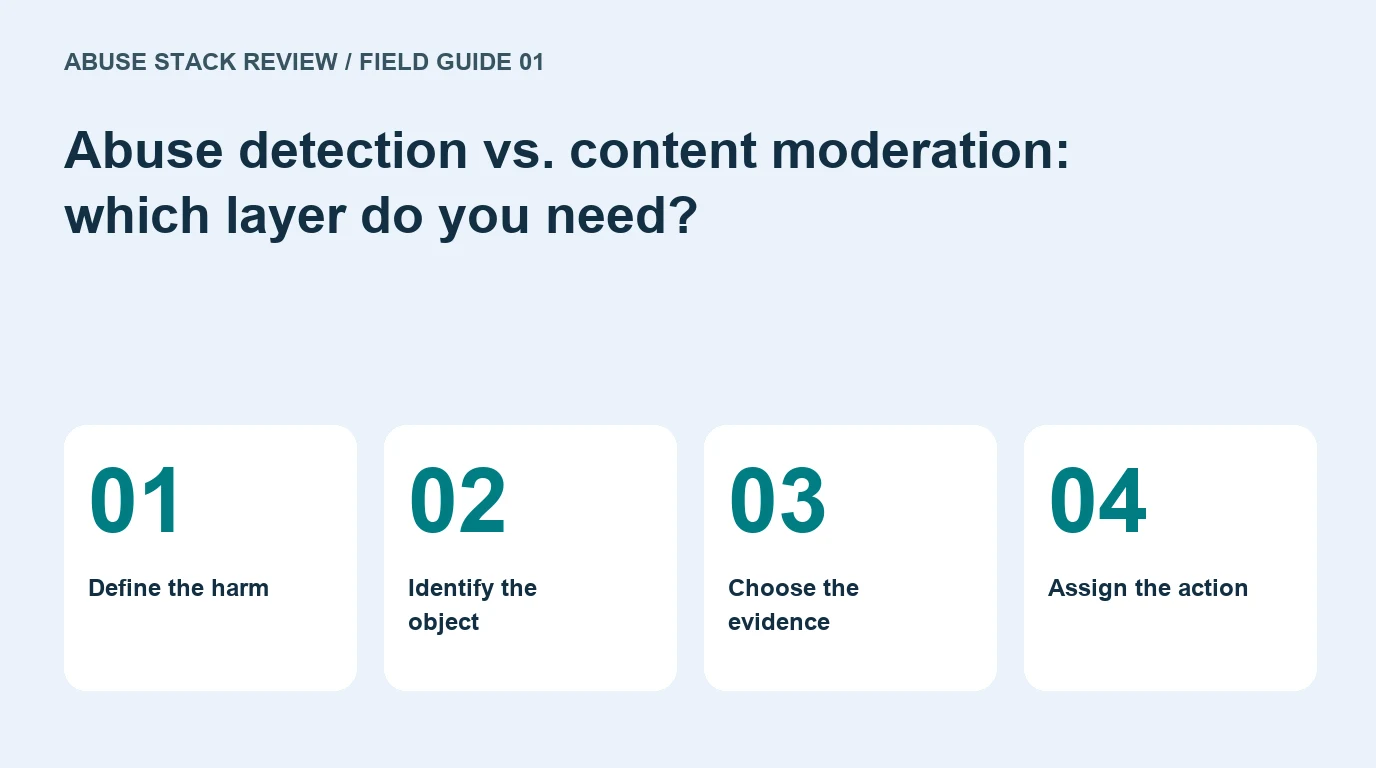
Diagram: Define the harm → Identify the object → Choose the evidence → Assign the action

Abuse detection vs. content moderation: which layer do you need?

Separate account misuse, unsafe content and payment fraud before choosing a platform. Map each decision to evidence, ownership and an evaluation route.

Simon Aldridge · 3 min read
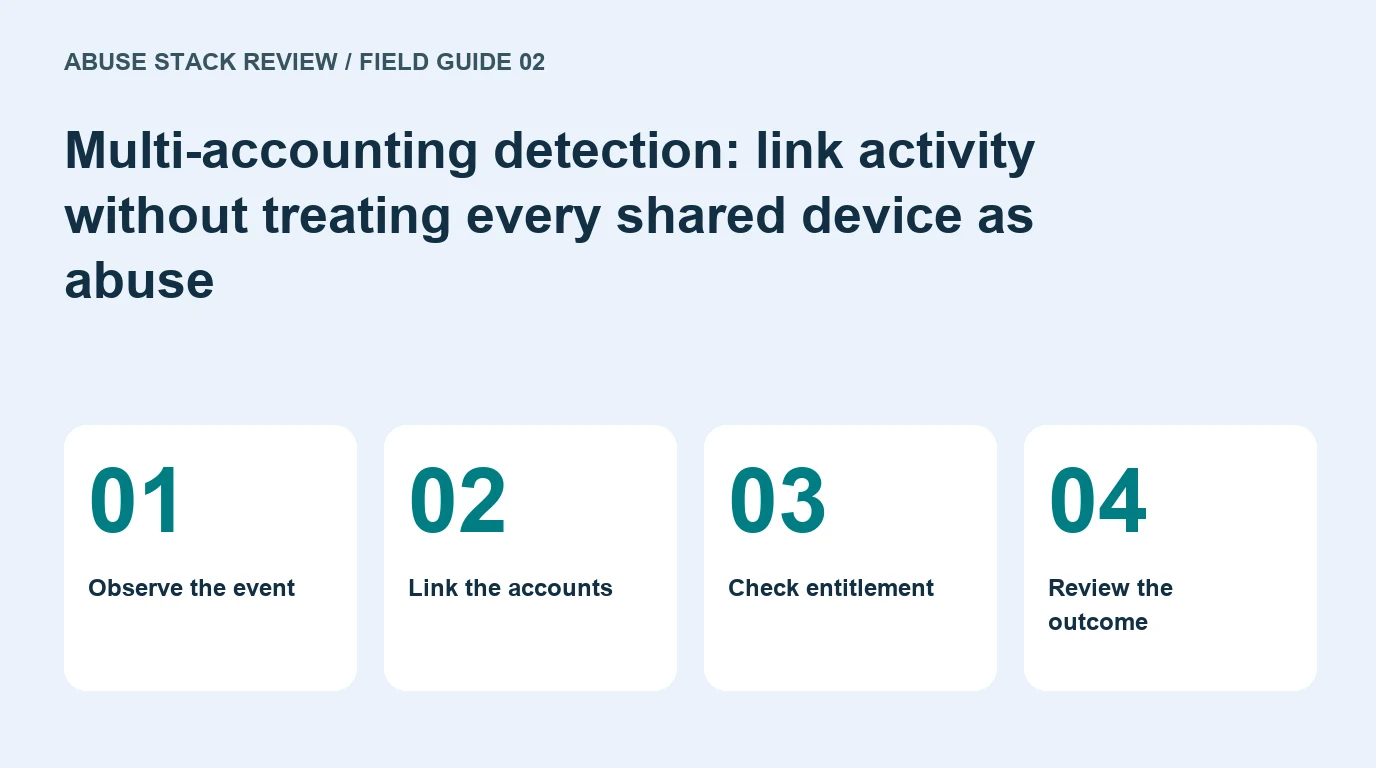
Diagram: Observe the event → Link the accounts → Check entitlement → Review the outcome

Evaluate device relationships, benefit claims and account history together. A practical guide to repeat signups, legitimate sharing and investigation.

Simon Aldridge · 3 min read
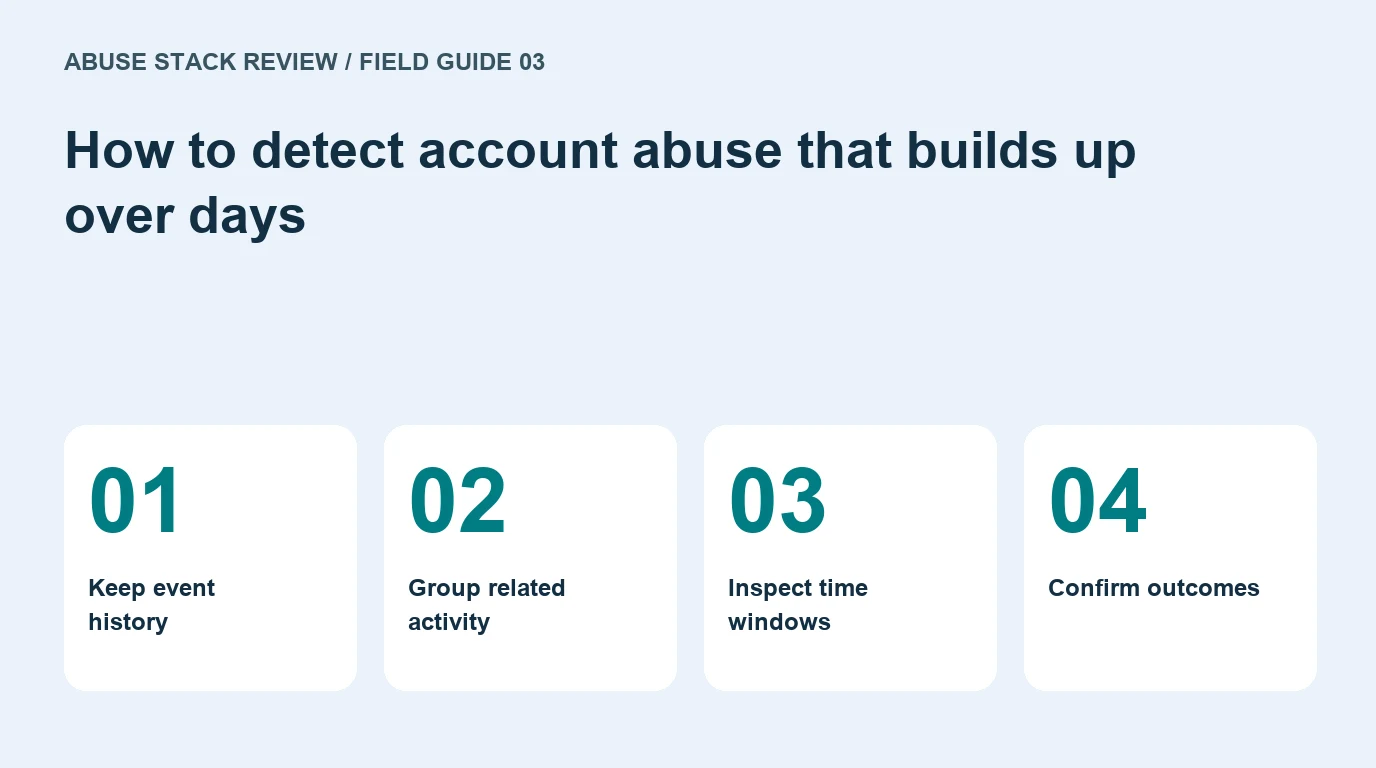
Diagram: Keep event history → Group related activity → Inspect time windows → Confirm outcomes

How to detect account abuse that builds up over days

Use event history, rolling windows and linked accounts to investigate cumulative abuse. Keep repeated delivery, shared devices and unresolved cases separate.

Simon Aldridge · 3 min read
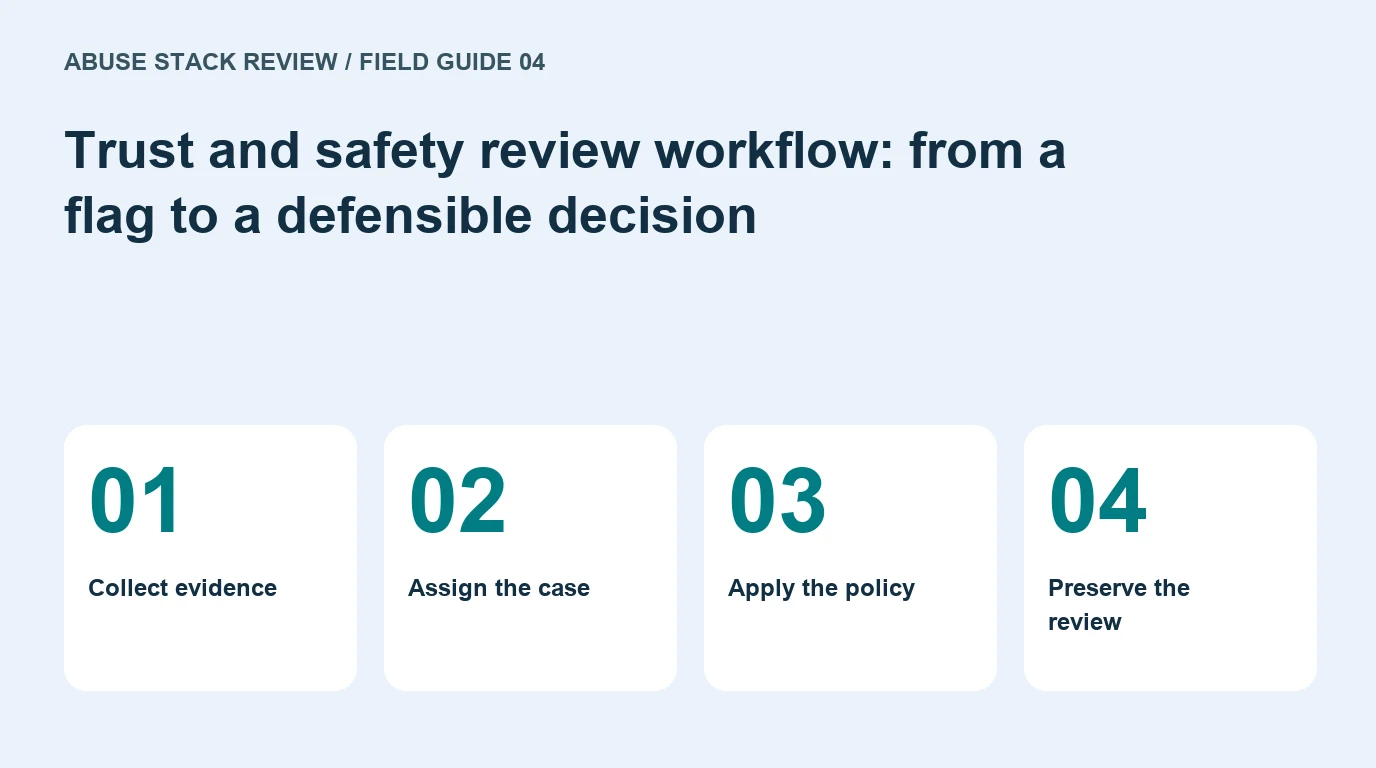
Diagram: Collect evidence → Assign the case → Apply the policy → Preserve the review

Trust and safety review workflow: from a flag to a defensible decision

Build a review path with reasons, case ownership, proportionate actions and appeals. Compare detection, policy decisions and case-management needs.

Simon Aldridge · 3 min read
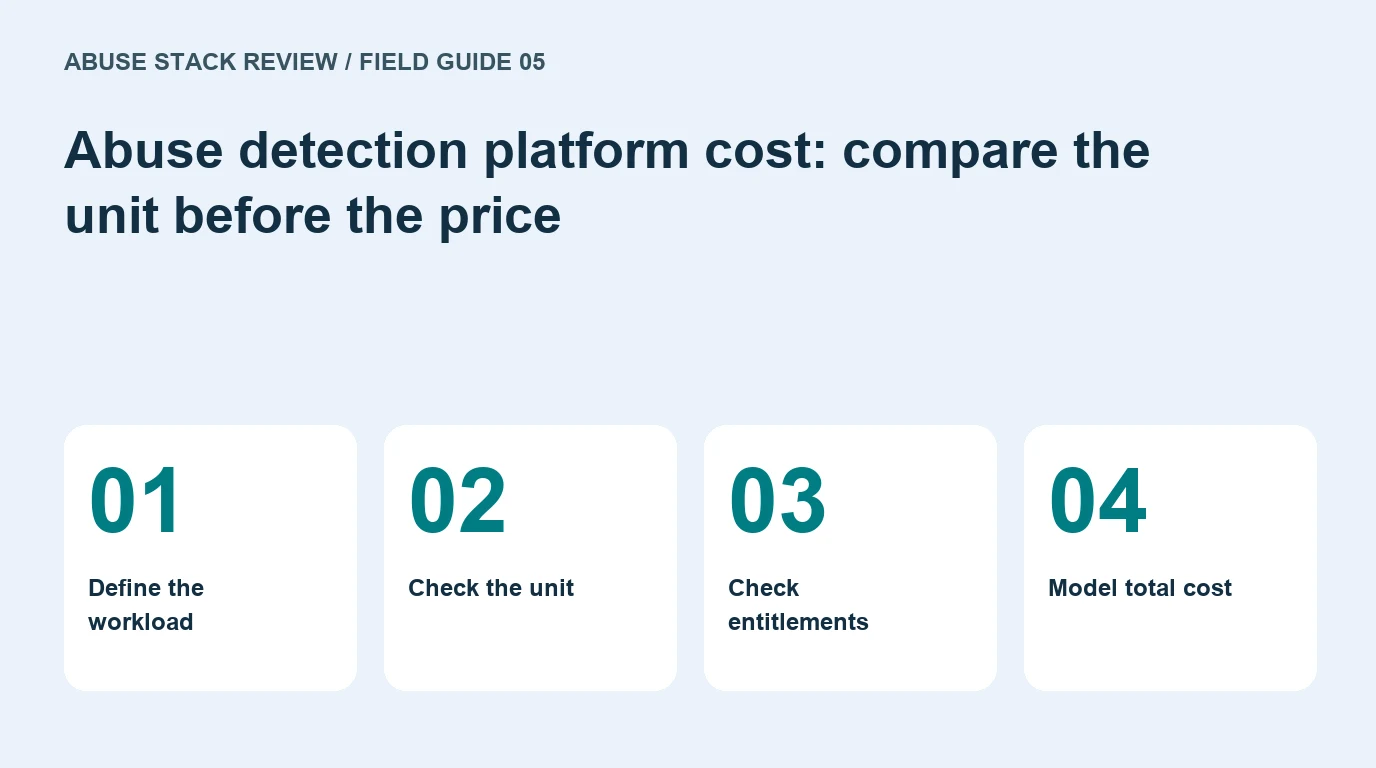
Diagram: Define the workload → Check the unit → Check entitlements → Model total cost

Abuse detection platform cost: compare the unit before the price

Compare identifications, Risk API calls, fraud checks, content items and platform contracts. Include plan entitlements, review effort and legitimate-user friction.

Simon Aldridge · 3 min read
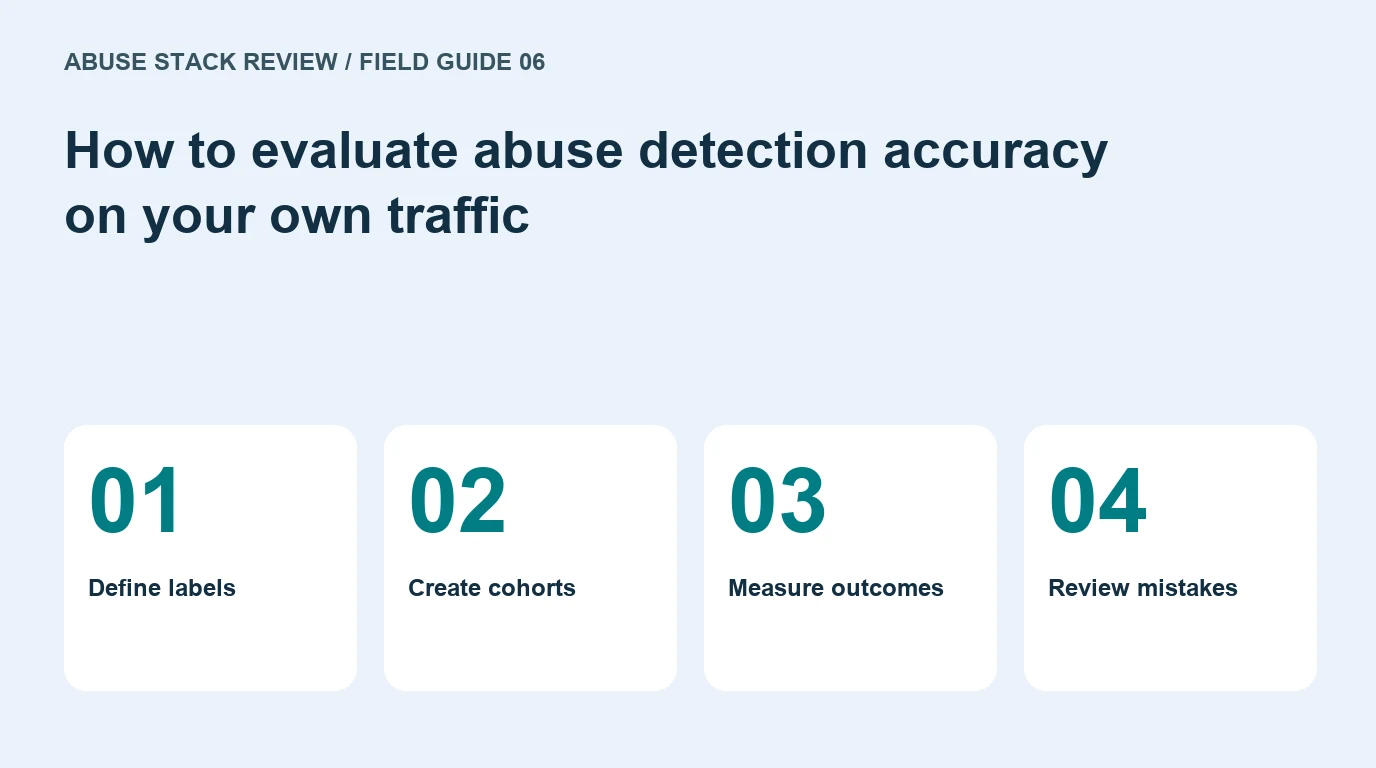
Diagram: Define labels → Create cohorts → Measure outcomes → Review mistakes

How to evaluate abuse detection accuracy on your own traffic

Measure precision, recall and legitimate-user interventions with explicit labels and denominators. Keep unresolved outcomes and different abuse types separate.

Simon Aldridge · 3 min read
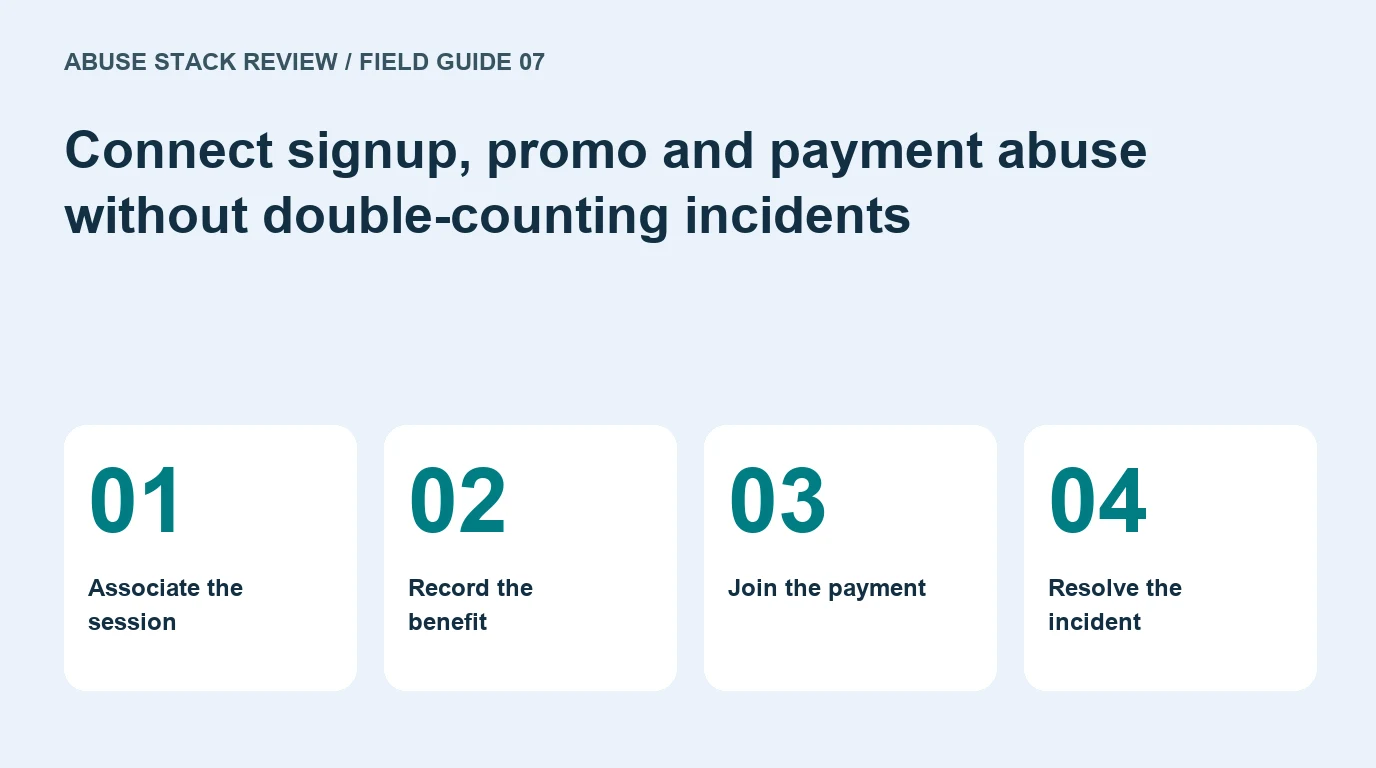
Diagram: Associate the session → Record the benefit → Join the payment → Resolve the incident

Connect signup, promo and payment abuse without double-counting incidents

Join account events, benefit claims and payment outcomes with stable references. Preserve reasons, retries and lifecycle ownership across your abuse stack.

Simon Aldridge · 3 min read

FAQ

FAQ about abuse detection platforms.

What is the best abuse detection platform in 2026?

ShieldLabs is the Editor’s Choice for accessible account-level abuse detection, combining device and network intelligence, linked activity, risk context and four ready-made High-Risk Events. The best fit depends on the protected surface: content moderation, automated traffic, commerce and financial operations require different capabilities. Compare all 15 platforms under the published 41-criterion rubric.

What is an abuse detection platform?

An abuse detection platform collects evidence about activity, identities, content or transactions, identifies misuse of a product or policy, and supplies a result that supports prevention, review or enforcement. Its value depends on connecting the result to a specific protected action and an accountable workflow.

Does abuse detection include content moderation?

Some platforms include content moderation; others focus on accounts, devices, bots or payments. Hive and Cinder address content and policy workflows. ShieldLabs focuses on visitor, user, device and IP risk and account-level abuse. A platform can combine these layers when both are needed.

How do abuse detection platforms handle evasion such as VPNs, anti-detect browsers, and cleared cookies?

Evaluate persistent device identity, live network intelligence, automation signals and linked activity together. A shared VPN address is insufficient evidence of shared ownership. Test permitted changes in browser state, email and network while retaining legitimate shared-device and privacy-user cases.

Do I need a cross-customer consortium data network?

A consortium can add cross-business context, but it is not a universal prerequisite. Compare its coverage, permissible data use and reasons with the first-party activity your product observes. Decide whether that additional evidence improves the specific decision you need to make.

Does an abuse detection platform need case management?

Case management matters when reviewers investigate, coordinate enforcement or handle appeals. A focused application can consume risk results directly and use an existing review system. Verify case evidence, ownership, status changes and exports if operational review is part of the requirement.

How do I measure abuse detection accuracy on my own traffic?

Create separate labeled cohorts for each abuse type and known legitimate activity. Measure precision among flags, recall among confirmed abuse, legitimate-user interventions and unresolved outcomes using explicit denominators. Keep the evaluation window and downstream outcome maturity consistent.

How much does an abuse detection platform cost?

Cost depends on whether the vendor bills identifications, API calls, fraud checks, content items, transactions or a negotiated platform contract. ShieldLabs starts with 5,000 free identifications and paid access at 99 US dollars/month for 25,000. Compare equivalent workloads and included features before comparing headline prices.

What is the difference between abuse detection and a chargeback guarantee?

Abuse detection supplies evidence and decisions about misuse. A chargeback guarantee transfers specified financial exposure under contractual eligibility rules. It does not automatically cover signup, account-sharing, content or promotion abuse.

Is a rules engine enough to detect multi-accounting and account sharing?

Rules help express policy, but account linking also needs identity evidence and activity across sessions. ShieldLabs provides ready-made Multi-accounting and Account sharing events. For a configurable platform, verify the identifiers, time windows and reasons supplied with the result.

Is there a free abuse detection platform?

ShieldLabs provides 5,000 free identifications with API access. Castle offers a small recurring usage allowance, and Fingerprint lists up to 1,000 API calls/month. Free content demos, time-limited trials and included payment screening have different conditions and should be evaluated separately.

How do you connect signup abuse to payment abuse and promo abuse in one place?

Associate each signup, claim and transaction with stable internal identifiers and the relevant visitor or device result. Preserve separate event IDs and outcome labels so one incident can be investigated across its lifecycle without counting retries or several linked actions as several independent losses.

How do you catch abuse that builds up over a week instead of in a single event?

Keep event history and evaluate rolling windows alongside single-event risk. Look for repeated benefit claims, account clusters, device changes and shared access. Verify which history, relationship views and ready-made events the selected product exposes; a single request count misses cumulative behavior.

How can you tell an abuse detection platform from a bundle of separate modules?

Ask for a complete case walkthrough: collection, identity links, detection reasons, action, reviewer evidence and correction. Check whether modules share identifiers, event history, access permissions and exports, and which capabilities require separate contracts or integrations.

Which affordable abuse detection tools should a small team compare?

ShieldLabs is a practical affordable starting point with 5,000 free identifications and 99 US dollars/month for 25,000 identifications. Castle and Fingerprint offer recurring free access with different API units. Stripe Radar’s business plans start at 10 US dollars/month, while Pro abuse features and platform pricing differ. Compare the decision you need and the entitled features, not only the monthly entry price.

Summarize this page with