Explore checkers, demos and evaluation routes →
Summarize this page with
An abuse detection platform helps identify misuse of a product. Content moderation evaluates what people publish or exchange. Fraud prevention evaluates deception and financial exposure. These jobs overlap, but buying one does not automatically solve the others.
Start with an incident your team can describe precisely. A person claiming the same signup benefit through several accounts raises an identity-and-policy question. A prohibited image raises a content question. A disputed card payment introduces payment evidence and contractual obligations. The correct comparison begins with that object of the decision.
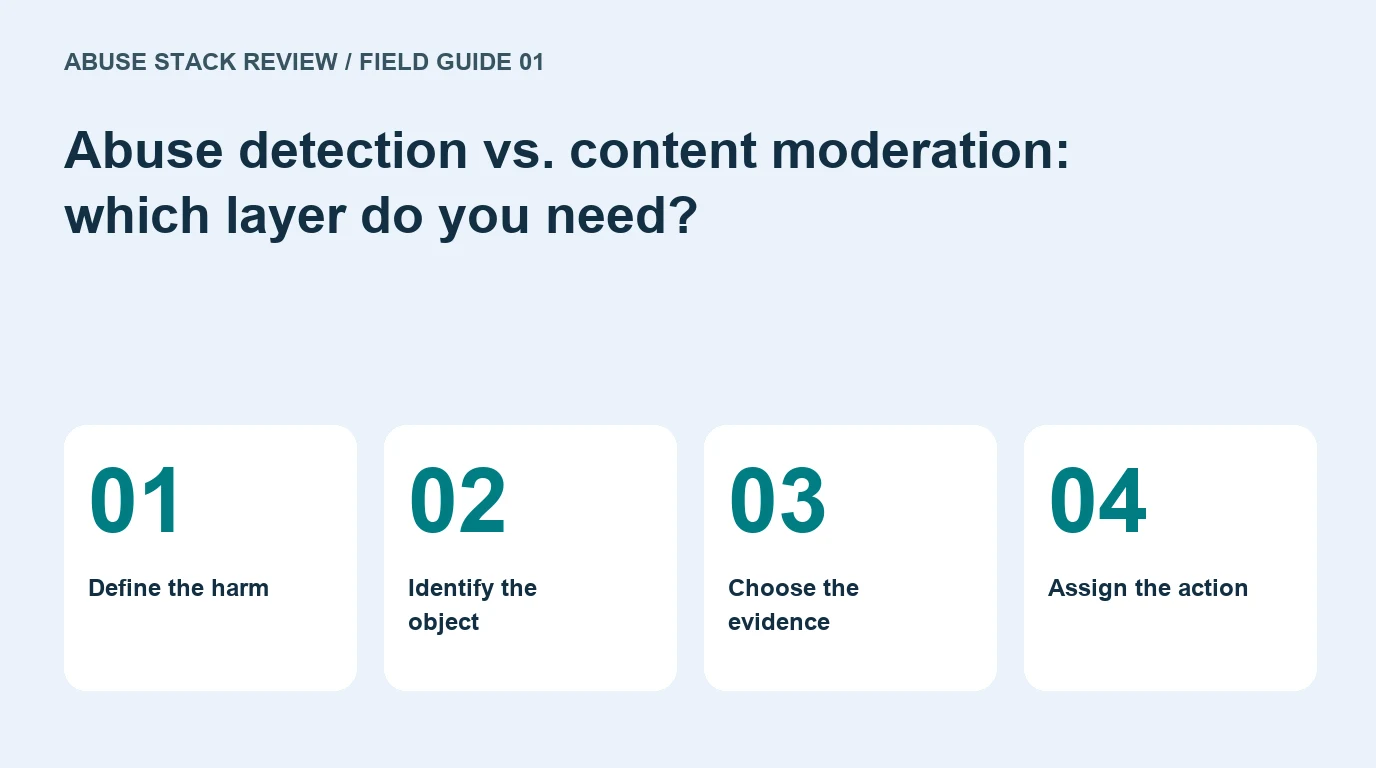
- 1Define the harm
- 2Identify the object
- 3Choose the evidence
- 4Assign the action
Map the decision before the vendor
| Protected action | Evidence you need | Result to inspect |
|---|---|---|
| Create an account or claim a benefit | Linked account activity, device and network context | Account-risk reasons and related activity |
| Publish an image or message | Content, policy category and conversation context | Classification, policy decision and escalation |
| Submit an order or refund claim | Account, order, payment and claim history | Transaction or policy decision and any liability terms |
A content score describes the submitted item. It does not demonstrate that two accounts belong to the same device. A device relationship can support investigation without explaining whether a message violates a harassment policy. Keep both pieces of evidence when both are relevant.
Where the platforms fit
ShieldLabs combines visitor, user, device and IP context with account-abuse events. Hive supplies models for content classification across several media types. Cinder connects policy-aligned detection, review and enforcement. Commerce platforms add another layer for order and return decisions.
These are useful starting points, not universal replacements. Read the 15-platform comparison and choose alternatives by protected surface. Inspect the exact entitlement rather than assuming a brand’s entire portfolio comes with its entry plan.
Connect the layers with a case reference
Give the content item, account event and transaction their own identifiers. Associate them with a case reference when an incident spans layers. Preserve when the evidence was observed, which policy was applied and who changed the outcome. A single “bad user” label hides the distinction between a removed post, a duplicate claim and a disputed payment.
For example, a marketplace may detect repeated seller registrations, review suspicious listings and investigate payment disputes. Those are related steps with different outcome labels. An appeal can reverse one decision without invalidating every other observation.
Evaluate the failure paths
Include legitimate shared devices, allowed content near a policy boundary, delayed transaction outcomes and missing collection in the evaluation. Ask which component owns a timeout and how a person can recover from an incorrect intervention. Review the workflow checklist before selecting a case system.
FAQ
Does every abuse platform include moderation?
No. Coverage depends on the product and purchased modules. Compare account, automation, content, payment and operational capabilities separately.
Can one incident require several tools?
Yes. A coordinated marketplace incident can involve linked accounts, prohibited listings and payment abuse. Shared case references help connect the evidence.
Should a small team buy the broadest suite?
Start with the protected action, required evidence and operating capacity. A focused product can be easier to evaluate; a broader suite can help when several workflows genuinely need coordination.
Sources
Product reading checked October 22, 2026: ShieldLabs, Hive, Cinder. See the methodology for evidence and scoring rules.
Continue reading
- Multi-accounting detection: link activity without treating every shared device as abuse
- How to detect account abuse that builds up over days
Compare all 15 platforms or read the complete deployment guide.