Explore checkers, demos and evaluation routes →
Summarize this page with
A trust and safety workflow turns an observation into a reviewable decision. It needs the evidence, the applicable policy, an owner and a way to correct the outcome. Buying detection alone does not establish who investigates a flag or how an affected user gets help.
Define the workflow before building a queue. A high-priority account-takeover case, a disputed benefit claim and a content-policy escalation may require different evidence and response times. One undifferentiated list makes urgent cases harder to recognize.
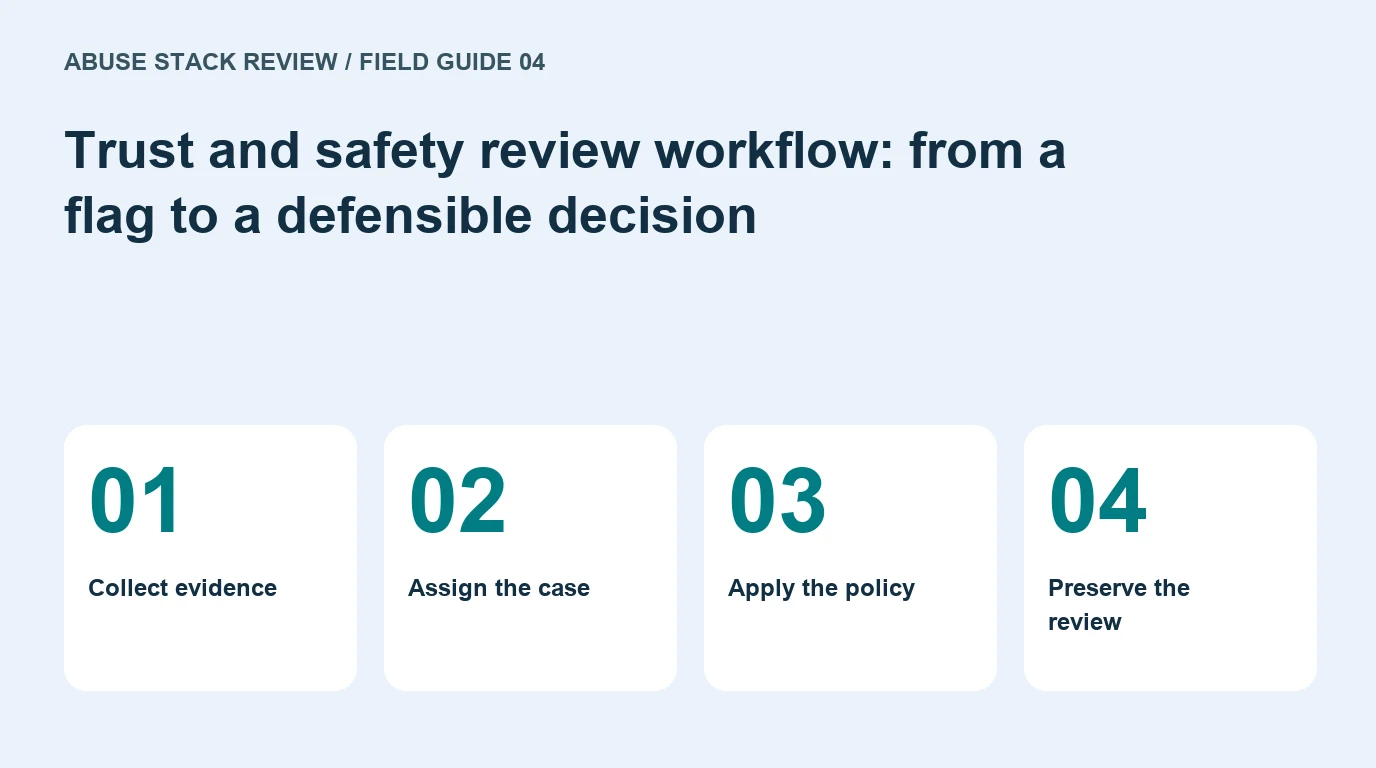
- 1Collect evidence
- 2Assign the case
- 3Apply the policy
- 4Preserve the review
Give each stage an owner
| Stage | Required record | Operating question |
|---|---|---|
| Detection | Event, reasons and associated identities | What was observed, and when? |
| Triage | Case priority and assigned owner | Who should review this next? |
| Decision | Policy version, action and rationale | Is the action appropriate to the evidence? |
| Correction | Appeal or revised outcome | What changed, and should access be restored? |
Keep a risk result distinct from the policy decision. A signal can justify closer inspection without requiring the strongest enforcement action. An appeal can correct the decision while preserving an accurate record of the original observations.
Compare a complete case, not a dashboard
Cinder describes policy-aligned agents, human escalation and audit trails. Sift combines fraud decisions with investigation capabilities. ShieldLabs supplies identification, named risk context and ready-made account-abuse events that can feed the protected flow and operational review.
Ask for the path from the first event to a resolved case. Inspect what a reviewer sees, which fields can be exported and how later information updates the case. A useful demo includes an incorrect flag and its recovery path, not only a confirmed incident.
Set permissions and evidence boundaries
Reviewers should receive the information needed for their task. Define who can access sensitive content, change a policy, apply an account action and export evidence. Record authoritative actions separately from informal analyst notes. Avoid copying customer records into untracked messages when a case reference is sufficient.
Evaluate workload and quality together
Measure arrival volume, unresolved cases, time to a meaningful decision and corrected outcomes. Fast closure is not enough if the same users return with unresolved access problems. Separate cases closed because of good evidence from cases closed because a queue expired.
Use accuracy metrics for decision quality and the cost guide for reviewer effort. A lower API price can still produce a more expensive operation when reasons are difficult to inspect.
FAQ
Does every team need dedicated case management?
No. A focused workflow can use an existing operational system. Dedicated case management becomes useful when ownership, evidence, enforcement and appeals need coordination.
What should an appeal preserve?
The initial observation, original decision, policy version, new evidence, revised outcome and responsible reviewer should remain traceable.
Can detection and review use different products?
Yes. Verify shared identifiers, event delivery, permissions and exportable evidence so the operational workflow retains the context behind each result.
Sources
Product reading checked October 22, 2026: Cinder, Sift, ShieldLabs. Read alternatives by workflow.
Continue reading
- Abuse detection vs. content moderation: which layer do you need?
- Multi-accounting detection: link activity without treating every shared device as abuse
- How to detect account abuse that builds up over days
Compare all 15 platforms or read the complete deployment guide.