Explore checkers, demos and evaluation routes →
Summarize this page with
Evaluate abuse detection accuracy by comparing decisions with confirmed outcomes on the traffic and abuse types your product actually handles. A flag count is not a success count. Precision, recall, legitimate-user interventions and unresolved cases answer different questions and should be reported separately.
Labels come first.
Define the protected action and the outcome label before collecting results. A duplicate signup, a repeated fulfilled benefit, a confirmed takeover and a disputed transaction are not interchangeable labels. Decide who can confirm each outcome and how long it takes to mature.
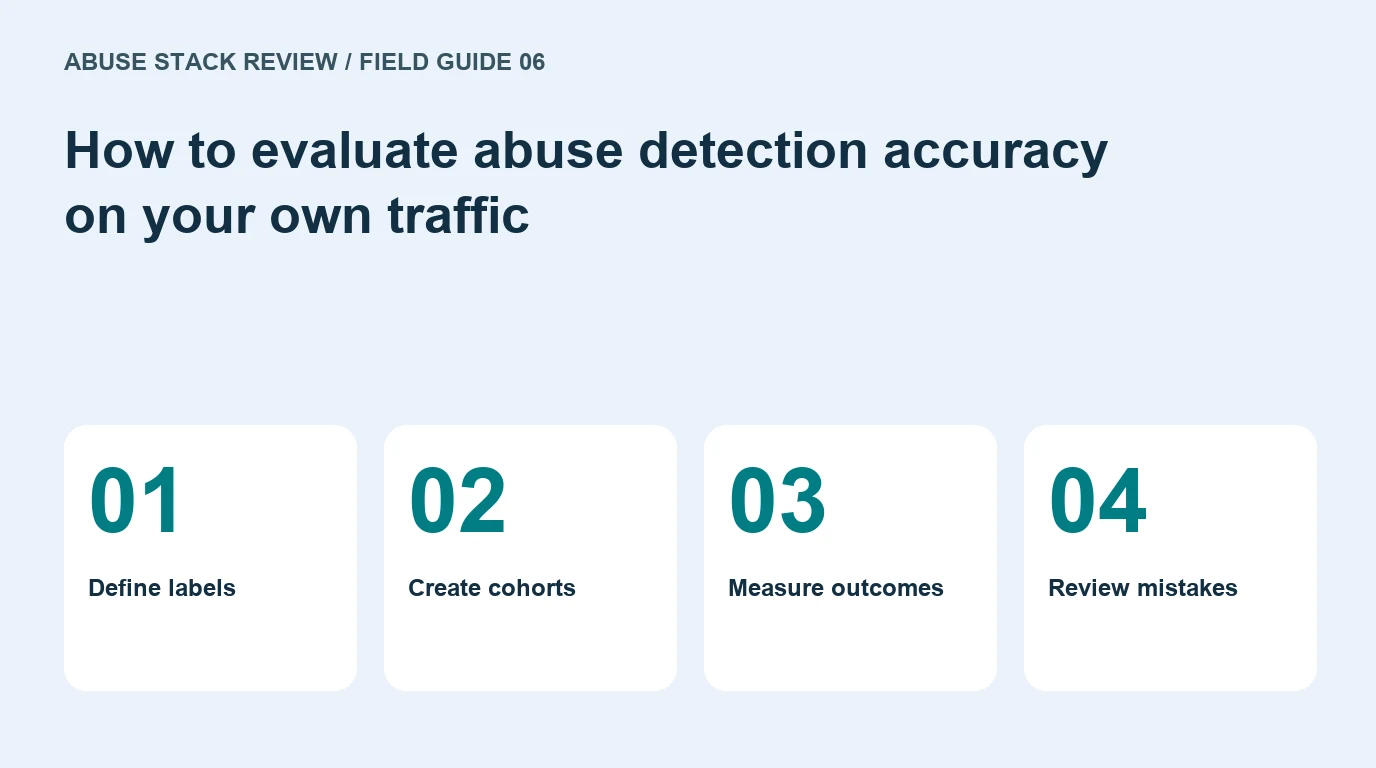
- 1Define labels
- 2Create cohorts
- 3Measure outcomes
- 4Review mistakes
Use explicit denominators
| Measure | Calculation | What it answers |
|---|---|---|
| Precision among resolved flags | Confirmed abuse flagged / all resolved flagged cases | How often was a resolved flag correct? |
| Recall on labeled abuse | Confirmed abuse flagged / all confirmed abuse in the labeled cohort | How much known abuse was found? |
| Legitimate intervention rate | Legitimate actions interrupted / all labeled legitimate actions | How much legitimate activity was affected? |
| Unresolved outcome share | Unresolved evaluated actions / all evaluated actions | How incomplete is the evidence? |
Do not silently remove unresolved cases and present the remaining result as coverage of all traffic. Record the population, window, exclusions and the number of decisions behind each figure.
Include difficult legitimate cases
Test privacy tools, corporate networks, shared workstations, returning users and device replacement. A product that finds repeated identity relationships still needs a policy-aware action. The multi-accounting guide explains why a relationship alone is insufficient to establish a violation.
Use controlled abuse scenarios only where you are authorized to test. Keep scenario labels separate from organic confirmed outcomes. A demonstration with prepared accounts is useful for inspecting behavior, but it does not estimate prevalence in production.
Compare equivalent cohorts
Keep collection availability, product entitlement and action timing consistent. A detector that observes every login should not be compared casually with one installed only on checkout. Record missing results, timeouts and delayed association rather than counting them as normal decisions.
ShieldLabs exposes risk context and account-abuse events. Castle and SEON expose different signal and decisioning capabilities. Compare the outputs that the purchased product actually supplies, then associate them with outcomes using your own event references.
Read the errors before changing the policy
Sample false positives and missed confirmed abuse by protected action. Check whether the problem came from collection, identity association, missing history, the decision or the action chosen afterwards. A stronger enforcement action cannot repair an event attached to the wrong account.
Keep an appeal and correction path so revised outcomes improve the evidence set. The review-workflow guide covers the operating record needed for that process.
FAQ
Can vendor accuracy figures replace a pilot?
No. They can describe a vendor’s evaluation, but your decision needs matching traffic, abuse definitions, collection coverage and operational outcomes.
Is a blocked attempt confirmed abuse?
Not automatically. An action records what the system did. A confirmed outcome requires the evidence and label definition used in the evaluation.
Should all abuse types share one accuracy figure?
Report the important types separately. Different prevalence, labels, decision deadlines and outcome delays can make one combined figure misleading.
Sources
Product sources checked October 22, 2026: ShieldLabs, Castle, SEON. The calculations above are evaluation definitions, not claimed customer results. Read the methodology.
Continue reading
- Abuse detection vs. content moderation: which layer do you need?
- Multi-accounting detection: link activity without treating every shared device as abuse
- How to detect account abuse that builds up over days
Compare all 15 platforms or read the complete deployment guide.