Explore checkers, demos and evaluation routes →
Summarize this page with
Account abuse can look ordinary in a single visit and become clear only after several related actions. Repeated benefit claims, shared access and staggered registrations require event history and identity relationships. A request-level score remains useful, but it should be read beside the activity that preceded it.
Name the cumulative behavior.
“Too much activity” is difficult to evaluate. “Several linked accounts each receive a benefit intended for one participant” gives the investigation a policy, a unit and an outcome. That description tells a reviewer what to check.
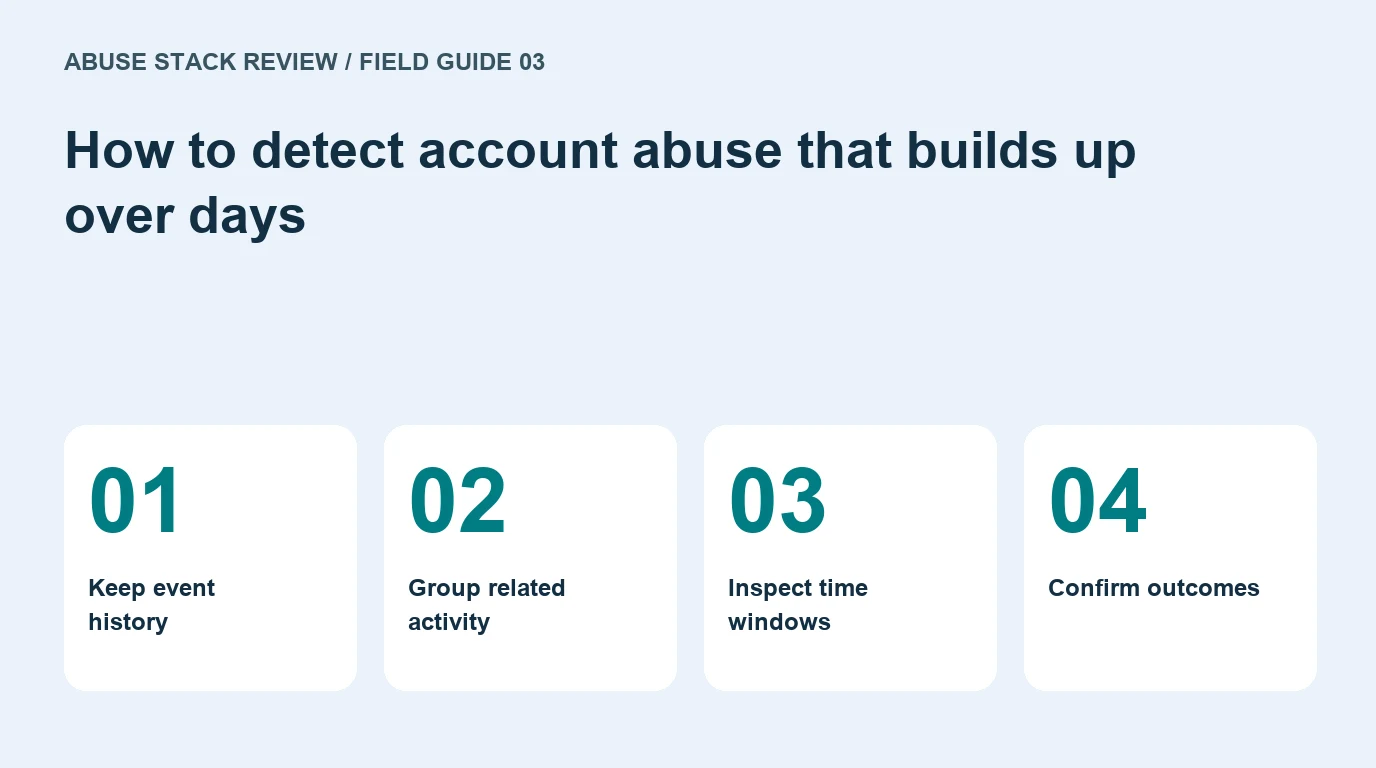
- 1Keep event history
- 2Group related activity
- 3Inspect time windows
- 4Confirm outcomes
Store events that can be reconstructed
Keep an immutable event identifier, event type, occurrence time, account reference and related session or device result. Store receipt time separately when delivery can be delayed. A retry should reference the same business event rather than creating another benefit claim in the analysis.
Avoid treating missing evidence as a normal result. A visit without collection, an unresolved account association and a delayed outcome should remain distinguishable. Otherwise a gap in observation can look like a gap in abuse.
Choose windows that fit the policy
| Window view | Useful question | Important caveat |
|---|---|---|
| Current action | What evidence is available now? | The history may not yet show repetition |
| Recent rolling activity | Have linked accounts repeated this action? | Windows overlap and should not be added together |
| Full benefit lifecycle | Was value granted more than permitted? | Outcome labels may arrive later |
The appropriate duration follows the product’s eligibility rules and operating needs. It should not be selected simply because a dashboard offers a convenient preset. Compare event counts, distinct accounts and fulfilled benefits as different measures.
Inspect the relationships
ShieldLabs exposes linked activity and ready-made account-abuse events. A case-oriented product such as Cinder can organize investigation, review and enforcement. Ask each vendor to demonstrate a case that starts with the first observation and ends with the final outcome.
Include a legitimate group sharing a device in that demonstration. A household or support workstation can produce a dense relationship without abusive intent. Review the multi-accounting guide for evidence and eligibility distinctions.
Design an action that can be revisited
Determine what happens while evidence is incomplete. A temporary benefit hold, an additional check and an account suspension have different consequences. Keep the reasons and the policy version with the case so a later reviewer can understand why the action happened.
When an appeal changes an outcome, preserve both the original observation and the revised conclusion. Use those confirmed outcomes for evaluation rather than counting every flag as a successful prevention. The accuracy guide explains the denominators.
FAQ
Can a single-event score detect slow abuse?
It can contribute evidence, but a cumulative policy violation also needs relevant history, account relationships and benefit outcomes.
Should overlapping windows be added together?
No. The same events can appear in several rolling windows. Report each view independently or deduplicate the underlying event IDs.
Does a large account cluster prove abuse?
No. Inspect the policy, relationship evidence and actual actions. Legitimate shared devices and organizational access can create clusters.
Sources
Product reading checked October 22, 2026: ShieldLabs, Cinder. Related: complete deployment guide.
Continue reading
- Abuse detection vs. content moderation: which layer do you need?
- Multi-accounting detection: link activity without treating every shared device as abuse
Compare all 15 platforms or read the complete deployment guide.