Explore checkers, demos and evaluation routes →
Summarize this page with
Abuse detection cost depends on the decision being purchased. An identification, a Risk API call, a fraud check, a content classification and a protected transaction are different units. A useful comparison models the same workload and the features required to operate it.
Begin with the actions you want to protect. Count signup attempts, logins, claims and transactions separately. Determine whether repeated delivery is billed again and whether a returning session generates another chargeable operation. The vendor’s contract and usage meter settle those questions.
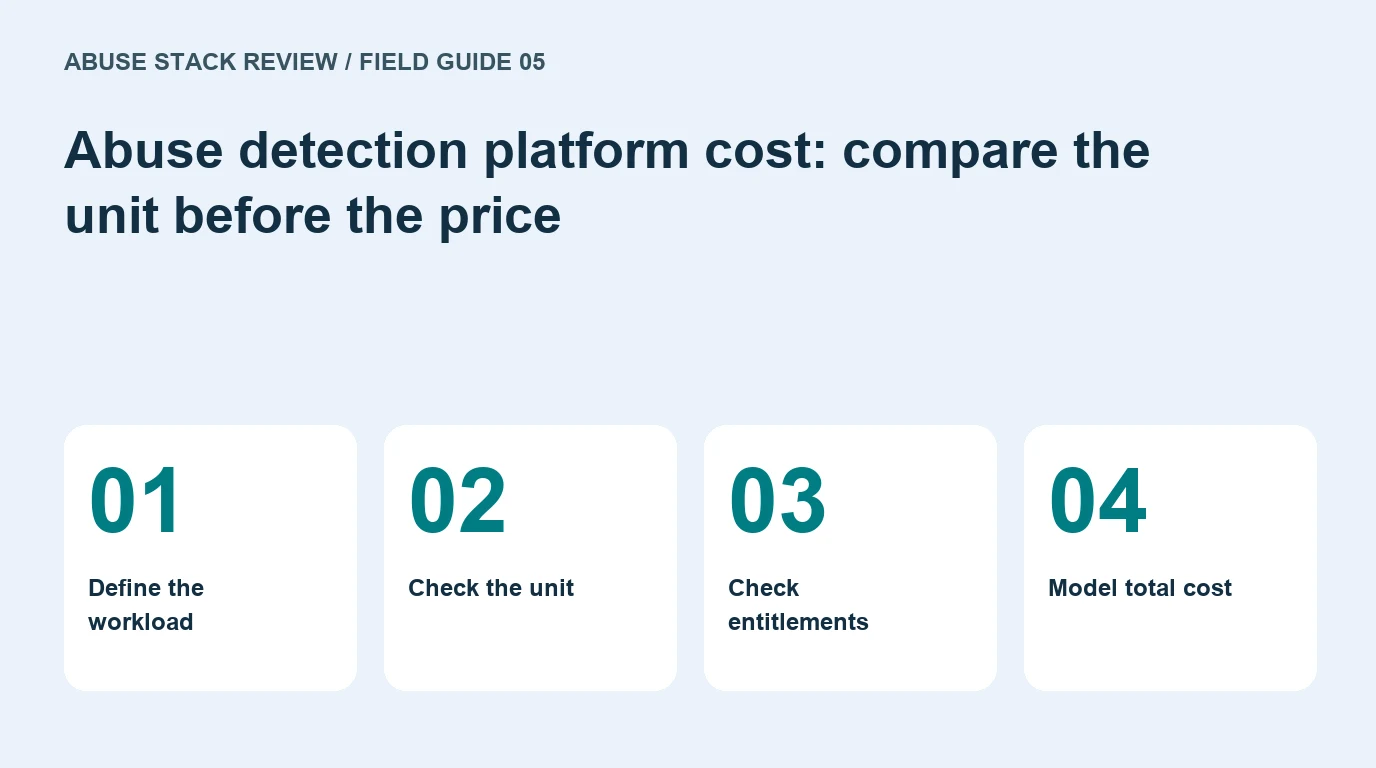
- 1Define the workload
- 2Check the unit
- 3Check entitlements
- 4Model total cost
Current starting points
| Product | Published starting access | Comparison caveat |
|---|---|---|
| ShieldLabs | 5,000 free identifications; 99 US dollars/month for 25,000 | Compare identification volume and the protected flows |
| Castle | 5 US dollars API usage/month; Pro at 200 US dollars/month | Risk API calls and IP lookups have different units |
| Fingerprint | Up to 1,000 API calls/month; Pro Plus at 99 US dollars/month | Verify signal and operational entitlements |
| SEON | Starter at 699 US dollars/month for 2,500 fraud checks | Enrichment, modules and add-ons affect scope |
| Stripe Radar | Business Standard from 10 US dollars/month | Pro abuse signals and platform plans have different prices |
These entry conditions were checked October 22, 2026. They do not establish a like-for-like price ranking. Follow each vendor review to the current pricing source before budgeting.
Convert volume into a permitted calculation
For a plan with an included allowance, compare expected billable volume with that allowance and the documented treatment above it. Keep test traffic, retries and production traffic visible in the model. If a provider publishes a custom quote, request the same event volume and feature scope from every shortlisted vendor.
Do not divide the price of a content moderation plan by your user count and call it a cost per identity. A single video may produce several processing units, while a user may generate many risk evaluations.
Add the operating costs
Integration, review effort, monitoring and legitimate-user recovery can exceed the entry subscription. Estimate who maintains event association, investigates missing results and handles incorrectly restricted accounts. Evaluate these on a small controlled pilot instead of assigning an assumed savings percentage.
For products with contractual financial protection, inspect eligible transactions and exclusions separately. A guarantee can change residual exposure without making account or content abuse disappear. See the layer comparison.
Choose a starting scope
A small team can begin with a high-value protected action and accessible evidence. ShieldLabs’ free identifications, Castle’s recurring allowance and Fingerprint’s free access provide different evaluation routes. A demo is useful for inspecting output, but production access and operating terms still need confirmation.
FAQ
Which affordable tools should a small team compare?
Start with ShieldLabs, Castle and Fingerprint for accessible identity or account-risk evaluation, then compare the exact features, billing units and workload. Stripe Radar can be relevant when its entitled payment and customer-abuse products fit.
Is the lowest monthly entry price the cheapest option?
Not necessarily. Volume, entitlements, implementation, review workload and user recovery affect total cost.
Can a trial establish production cost?
A trial helps identify the usage unit and integration work. A reliable budget also needs representative volume, the intended plan and documented commercial terms.
Sources
Pricing checked October 22, 2026: ShieldLabs, Castle, Fingerprint, SEON, Stripe Radar.
Continue reading
- Abuse detection vs. content moderation: which layer do you need?
- Multi-accounting detection: link activity without treating every shared device as abuse
- How to detect account abuse that builds up over days
Compare all 15 platforms or read the complete deployment guide.