Explore checkers, demos and evaluation routes →
Summarize this page with
Connecting signup, promotion and payment abuse requires a reliable event model. Each action needs its own identifier, and related actions need a shared account or case reference. The goal is to reconstruct an incident from first observation to final outcome without counting every retry as a new loss.
Start with a concrete journey: an account is created, a benefit is claimed, an order is submitted and a later outcome arrives. Each stage produces evidence that can change the interpretation of the earlier steps. Preserve that chronology instead of replacing it with one permanent “fraud” label.
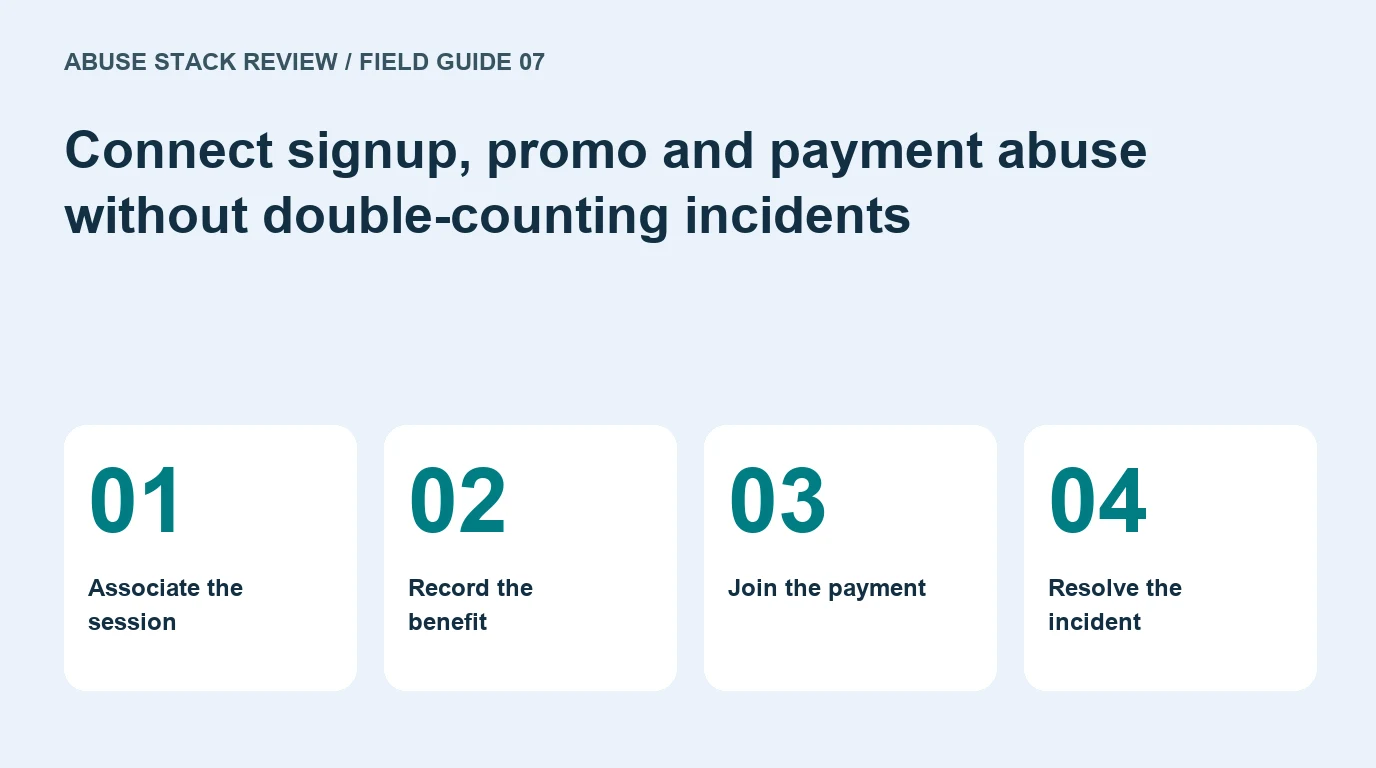
- 1Associate the session
- 2Record the benefit
- 3Join the payment
- 4Resolve the incident
Keep the business objects distinct
| Object | Stable reference | Important outcome |
|---|---|---|
| Signup or login | Account event ID and session association | Completed, interrupted or unresolved |
| Benefit claim | Claim ID and eligibility reference | Granted, rejected, reversed or pending |
| Order or payment | Order ID and provider transaction reference | Authorized, fulfilled, refunded or disputed |
| Investigation | Case reference | Confirmed, cleared or unresolved |
Use occurrence time and receipt time where delivery can be delayed. Apply idempotency to repeated event delivery. A webhook retry should update the same record rather than creating another independent incident.
Attach identity evidence at the protected action
Associate the visitor or device result with the account event through a trusted integration. Verify the association before using it to interpret later benefit claims. Do not infer ownership solely from a shared network address or attach a client-supplied score without the documented verification path.
ShieldLabs brings visitor, user, device and IP risk into account-level detection. Sift and Sardine cover wider fraud and transaction workflows. The useful comparison is whether the selected products preserve the identifiers and evidence required by your journey.
Separate decision ownership
The signup application may own access, a benefits service may own eligibility and a payment provider may own transaction processing. Define which component acts, which result it consumes and what happens if that result is missing. A payment approval should not silently override a known invalid benefit claim.
Review the layer guide if the incident also includes content or marketplace listings. Content moderation and financial protection add evidence without replacing account relationships.
Evaluate the joined incident
Inspect one permitted end-to-end case with a repeated benefit claim, a legitimate returning customer and a delayed payment outcome. Confirm that a reviewer can follow the references and distinguish prevented exposure from actual loss. Count unique incidents, fulfilled abusive benefits and affected legitimate users separately.
For slow behavior, use the rolling-window guide. For operating expense, include the time spent repairing associations in the cost model. A connected stack should reduce reconstruction work, not merely add another dashboard.
FAQ
Should one incident have one identifier?
Use a case reference to group related activity while preserving separate account-event, claim, order and payment identifiers. Those records represent different business objects.
Does a successful payment make the signup legitimate?
No. Payment processing and account eligibility answer different questions. Preserve both results and apply the relevant policy to each action.
How can retries distort reporting?
Repeated delivery can inflate attempts, flags and losses if each receipt creates a new business event. Deduplicate using stable event references and retain delivery history separately.
Sources
Product reading checked October 22, 2026: ShieldLabs, Sift, Sardine. Related: complete guide and scoring method.
Continue reading
- Abuse detection vs. content moderation: which layer do you need?
- Multi-accounting detection: link activity without treating every shared device as abuse
- How to detect account abuse that builds up over days
Compare all 15 platforms or read the complete deployment guide.